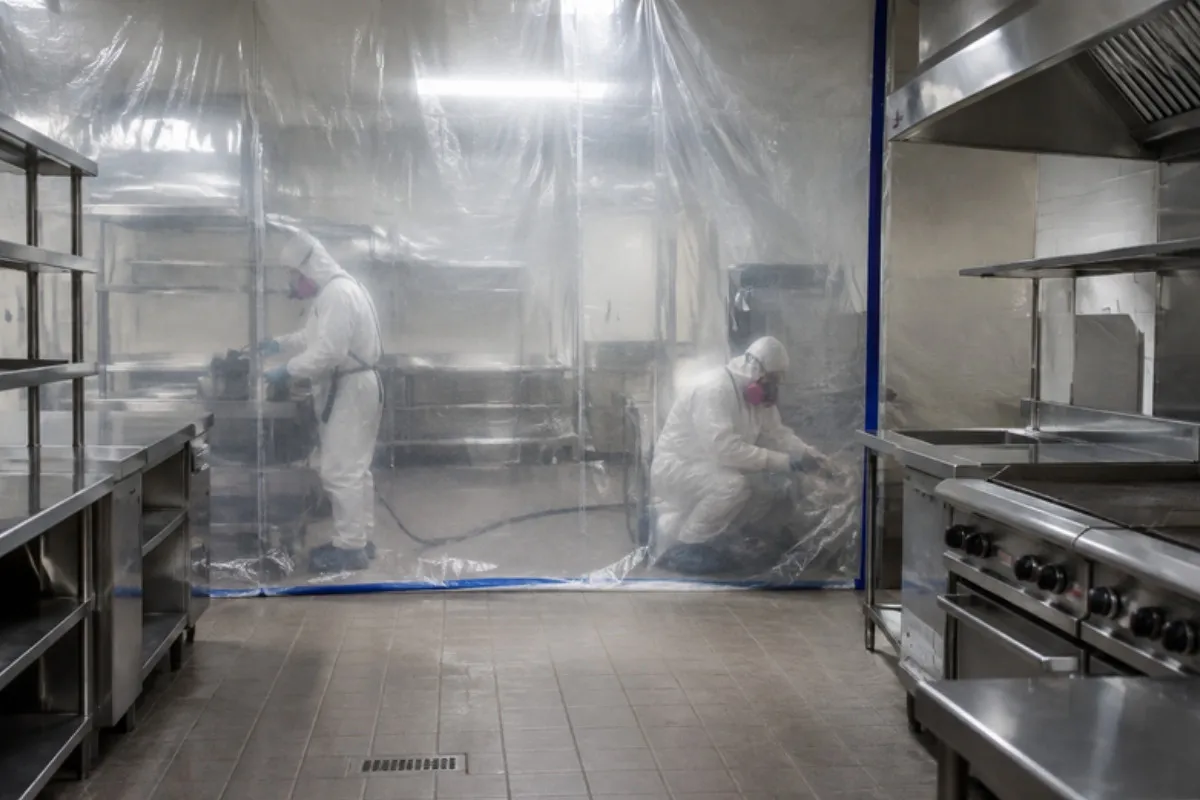
Commercial mold remediation in Kingston Springs is about restoring a shared building safely: stopping the moisture, isolating the area and removing what cannot be cleaned while staff and visitors are kept clear. EPA's commercial guidance scales that work to the size of the problem. Call the number on this page to be connected with a local mold remediation company in Kingston Springs.
Why buildings here hold moisture
Kingston Springs began as a mineral-springs resort on the Harpeth River and grew into a residential town after sewer service arrived in 1989. It sits about 19 miles from Nashville along Interstate 40. The river and its wooded floodplain along Burns Park and Harpeth River State Park keep the air damp much of the year. In the May 2010 flood, the Harpeth at Kingston Springs set a record crest far above the 1946 mark and carried off the river gauge, and floodwater flattened most of the wooded floodplain along Burns Park.
Older commercial buildings and rentals near the river, and newer ones with flat roofs or ceiling-mounted HVAC, all share the same weak points: roof leaks, condensation and plumbing in shared walls. A building that took water once is worth checking closely after every major rise, because hidden framing and wall cavities can stay damp long after the floor looks dry.
In-house cleanup or a remediation company?
| Situation | Who should handle it |
|---|---|
| Small spot on a hard surface, under about 10 square feet | Maintenance staff with gloves, goggles and an N-95 mask |
| Growth across a wall section, ceiling grid or carpet | A remediation company working inside containment |
| Mold in ducts or an air handler | A company that cleans HVAC systems; shut that zone off first |
| Any area that took river or storm water | Professional removal of porous materials and drying |

Signs to watch for
- Stained or sagging ceiling tiles after a storm
- A sour, earthy smell when the air system starts up
- Bubbling paint or soft drywall near restrooms and kitchens
- Condensation on windows, ducts or metal roof framing
Timing and seasons
Speed matters. EPA says wet materials should be dried within 24 to 48 hours; after that, assume growth has started. Spring storms and high Harpeth River levels are the usual triggers here, while summer humidity makes small problems spread. Plan disruptive work for evenings or a slow week where possible, and give tenants or members notice. Repairs to structural framing after removal need a permit from the Town of Kingston Springs Building and Codes on Spring Street, which issues permits through its iWorQ portal. Jobs of $25,000 or more require a Tennessee contractor's license, and splitting the work into phases does not get around that limit.
Commercial Mold Remediation questions in Kingston Springs
Which building materials usually have to be thrown out?
How quickly does a wet building need to be dried?
Can a large job be split into phases to stay under $25,000?
How do we know the job is finished?
More mold services in Kingston Springs
Commercial Mold Remediation nearby
Sources
- EPA: Mold Remediation in Schools and Commercial Buildings (pdf)
- EPA: Mold Cleanup in Your Home
- EPA: Homeowner's and Renter's Guide to Mold Cleanup After Disasters (pdf)
- EPA: Mold Information Slideshow (testing and sampling)
- TDCI: Bidding FAQs
- National Weather Service Nashville: May 2010 flood
- Kingston Springs, Tennessee (Wikipedia)
- Harpeth Conservancy: Retrospective on the May 2010 flood
- Town of Kingston Springs: Building and Codes
Last updated: