Mold Remediation Nashville is a free referral service, not a mold company, and it has no crews or inspectors of its own. Your call is routed to an independent local mold remediation company or mold inspector serving your area, who talks through the problem and quotes their own price. Call the number on this page to be connected with a local mold remediation company in Nashville.
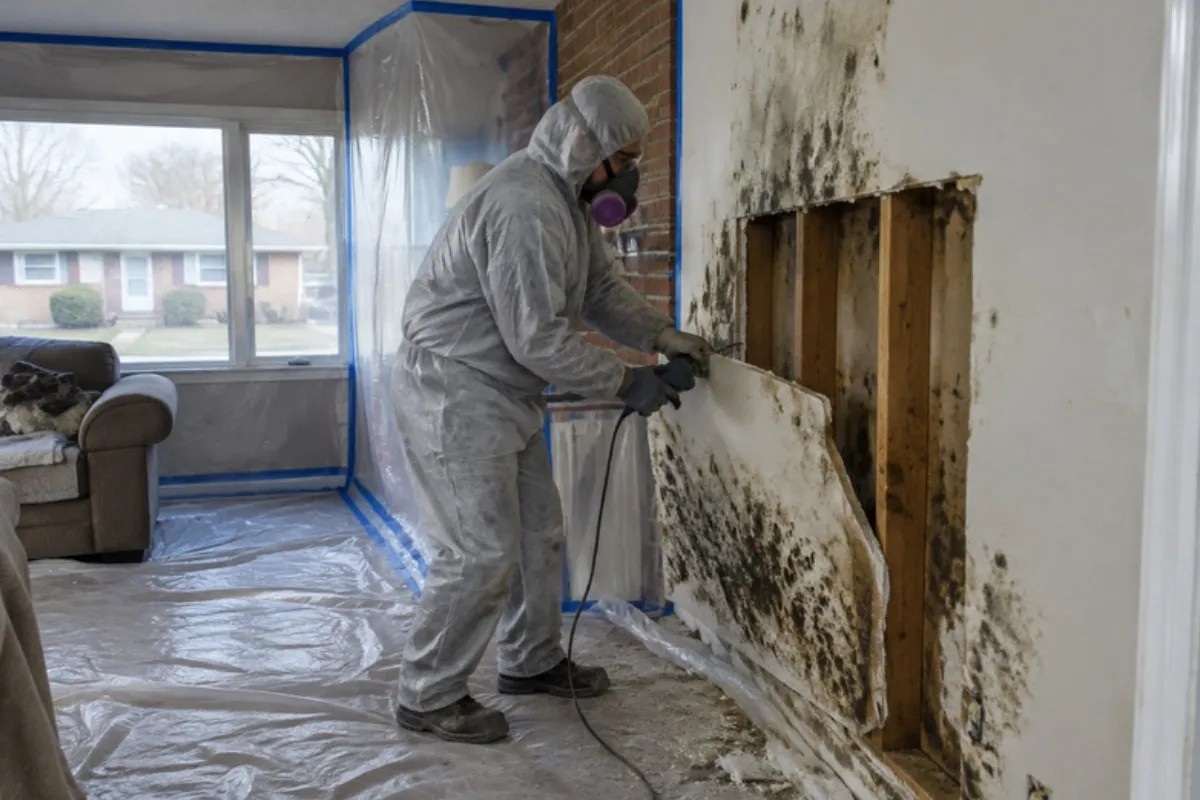
Mold services in Nashville
What happens when you call
The number on this page connects you with an independent business that takes mold work in and around Nashville. It helps to have a few things in mind before you dial: which room or space is affected, about how many square feet of growth you can see, what got wet (a leak, a flood, a sweating duct, a seeping wall) and how long it stayed damp. The company you reach decides whether a visit makes sense, explains what it would do, and gives you its own quote. You are under no obligation to hire anyone, and any agreement on price and scope is between you and that business.
Why Middle Tennessee homes grow mold
Nashville summers are long, hot and humid, and winters and springs are wet. A large share of Middle Tennessee houses sit over vented crawl spaces, where muggy outdoor air drifts in and condenses on cool floor joists and air conditioning ductwork. Older homes and houses on sloped lots often have basements, and below-grade walls tend to seep after heavy spring storms. Add karst terrain, sinkholes and a network of creeks feeding the Cumberland, the Harpeth and the Stones River, and there is no shortage of ways for water to get under a house.
Flooding is part of local history. On May 1 and 2, 2010, Nashville recorded 13.57 inches of rain in two days, and the Cumberland crested at 52.55 feet, far above its 40-foot flood stage. In late March 2021, 7 to 9 inches fell over the southern and eastern parts of the metro and flooded hundreds of homes and businesses. Metro Water Services shows regulated floodplains on FEMA flood maps you can view online or through Metro's Parcel Viewer, and it notes that property outside a mapped flood zone is not guaranteed to stay dry.
EPA and Metro's own mold handout agree on the first step: dry wet materials within 24 to 48 hours and fix the source of the water. If a flooded home could not be dried in that window, EPA says to assume mold is growing. EPA also recommends keeping indoor humidity below 60 percent, ideally 30 to 50 percent.
Inspection and remediation are different jobs
An inspection looks for moisture and growth, traces where the water is coming from and lays out what needs to be removed. Remediation is the physical work: sealing off the area, cutting out moldy drywall, insulation or carpet, cleaning framing and drying everything before it is closed up. EPA says that when mold is visible, sampling is usually unnecessary and there are no federal limits for mold spores, though surface sampling can help confirm an area was cleaned. Tennessee does not require the company that tests a home to be different from the one that removes the mold, but Angi recommends separate companies, and an independent inspector gives you an assessment and clearance check from someone with no stake in the size of the job.
Typical costs (national figures)
| Service (national ranges Angi reports) | Typical range |
|---|---|
| Mold remediation project | $1,223 to $3,758 |
| Crawl space mold | $500 to $2,000 |
| Basement mold | $500 to $3,000 |
| Mold inspection | $303 to $1,075 |
Middle Tennessee prices vary. The size of the affected area, how much material has to come out, how tight the crawl space or attic is, and whether ductwork is involved move the number most.
Checking a company's Tennessee license
A job of $25,000 or more requires a contractor who holds a Tennessee contractor's license, and the state's mold remediation classification is S-F. In Davidson, Robertson and Rutherford counties, residential projects from $3,000 up to $25,000 need the state Home Improvement license. Before work begins, look the company up on TDCI's Verify a License search.
Where calls are connected
The service covers Nashville and Davidson County (Metro) along with Williamson, Sumner, Wilson, Rutherford, Robertson, Cheatham and Maury counties.
On health, EPA says mold can irritate the eyes, skin, nose, throat and lungs, and people with asthma or weakened immune systems should stay away from moldy areas. Talk with a health professional about any health concerns.
Cities and towns we connect callers in
Davidson County
Williamson County
Sumner County
Wilson County
Rutherford County
Robertson County
Cheatham County
Maury County
Common questions
Is Mold Remediation Nashville a mold company?
Can the same company test and remove mold in Tennessee?
How big a mold problem can I handle myself?
Which areas does the service cover?
Guides
Sources
- EPA: Mold Cleanup in Your Home
- EPA: A Brief Guide to Mold, Moisture and Your Home
- EPA: Mold Information Slideshow (testing and sampling)
- EPA: Homeowner's and Renter's Guide to Mold Cleanup After Disasters (pdf)
- Metro Nashville: Mold, Moisture, and Your Home (pdf)
- Metro Water Services: Know Your Flood Hazard
- National Weather Service Nashville: May 2010 flood
- National Weather Service Nashville: March 27-28, 2021 flash flooding
- Tennessee Contractor Classification Outline (TDCI)
- TDCI: Bidding and Contractor License Requirements (pdf)
- Angi: How Much Does Mold Remediation Cost? (2026 data)
- Angi: How Much Does a Mold Inspection Cost? (2026 data)
- Angi: How to Hire a Mold Remediation Company
Last updated: